
Last Updated on 20 February 2026

In this guide, we provide you with a concise overview of the most important numbers and explain exactly when you should dial 112, 110, or the medical on-call service. This will help you stay safe while enjoying your time in Germany.
“Good preparation takes away the panic. It’s best to save these numbers directly in your contacts.”
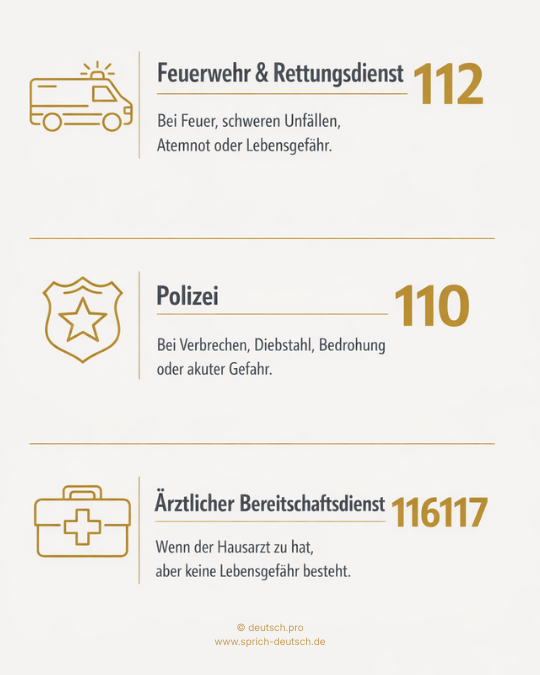
Fire department & emergency services – 112
112 is the general emergency number in Germany and is valid throughout Europe. Dial this number in acute, life-threatening emergencies. These include serious accidents, fires, breathing difficulties, heart attack symptoms, or loss of consciousness. By dialing 112, you will reach the integrated control center, which will immediately coordinate the fire department or ambulance.
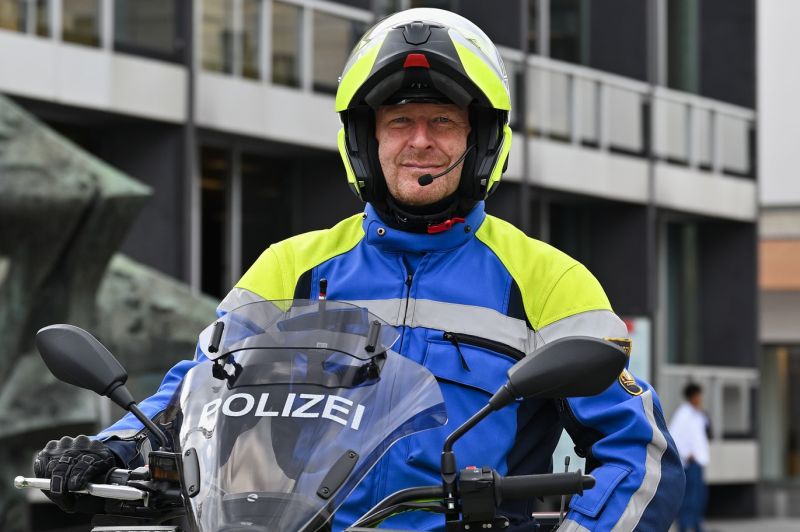
110 is the right choice if you need police assistance. This is the case for violent crimes, theft, robbery, serious traffic accidents, or if you feel threatened. The police will take your information and, if necessary, immediately send a patrol car to your location.
Try to describe the situation as objectively as possible: What happened? Who is involved? Did the perpetrators flee in a particular direction or did you note any vehicle license plate numbers?
Medical assistance without life-threatening conditions: 116117
Not every medical issue is a case for the emergency doctor. If you are ill (e.g., high fever at the weekend, severe earache at night) but your life is not in danger and the normal doctors’ offices are closed, dial 116117.
- Responsibility: Medical on-call service (nationwide without area code).
- Service: They will tell you the nearest emergency practice or, in urgent cases, send a doctor to your home.
- Tip: Take a look at our article on the healthcare system in Germany to understand how health insurance works.
Doing the right thing: The 5 W questions
When you make an emergency call, it is crucial to remain calm. The control center staff will guide you through the conversation, but it helps enormously if you keep the 5 W questions in mind:
- Where exactly is the emergency? (Address, floor, landmarks)
- What has happened? (Brief description of the situation)
- How many people are affected?
- What injuries or illnesses are involved?
- Wait for further questions! (Never hang up first!)
Other important numbers
In addition to the classic emergency numbers, there are two other services that can be very useful:
- Poison emergency number: Each state has its own number (e.g., Berlin 030 19240). Help with poisoning from chemicals, medications, or plants.
- Emergency pharmacy service: If you need medication urgently at night, you can find the pharmacy on duty via the website of the Aponet website.
Staying safe during your time in Germany
Familiarizing yourself with emergency numbers is an important step toward integration and safety. We hope you never have to dial these numbers, but if you do, you are now well prepared. Stay calm, speak clearly, and remember: helpers are there to support you.
FAQ: The most important questions about emergency numbers
1. Does an emergency call in Germany cost money?
No, calls to 112 and 110 are always free of charge, both from landlines and mobile phones.
2. Can I call the emergency number even if I don't speak German?
In many control centers, the employees speak English. Try to answer the 5 W questions in English if necessary, in case your German is not yet sufficient in a stressful situation.
3. What happens if emergency numbers are misused?
Deliberately dialing emergency numbers without an emergency (“prank calls”) is a criminal offense and can result in heavy fines or even imprisonment.
Have you had any experience with the German emergency call system?
Were you surprised at how quickly help arrived, or do you have any tips for other German learners? Leave us a comment and share your story with us!


I’m so very troumatise I need help I have a lot of thing I want to explain to police because I need help I live in campus Verden strass200
Dear Niyonsaba Philemon,
We are very sorry to hear it.
Unfortunately, we are the wrong address for such matters. Please contact the citizens’ office or associations that represent your compatriots in Germany. They will refer you to the relevant institutions.