

Last Updated on 14 March 2026

Why the Word “Scheiß-” Is Essential for Your German
When learning a new language, most people first want to know how to politely ask for directions or order a coffee. But the moment you are standing at a train station and the loudspeaker announces that your train is delayed by 60 minutes, you quickly realize that “Good afternoon” and “Excuse me” are not enough to express how you feel. You need a release. You need the word “Scheiße”.
In Germany, this word is everywhere. It is not just a simple swear word, but almost a cultural phenomenon. It brings people together in shared frustration about the weather, technology, or a dead phone battery. In this guide, we take a closer look at the world of the “S-word.” We explore why it is so flexible grammatically, how it compares to expressions in English or Spanish, and how you can use it without stepping into a social faux pas.
The Anatomy of a Curse: Why “scheiß-” Is So Functional
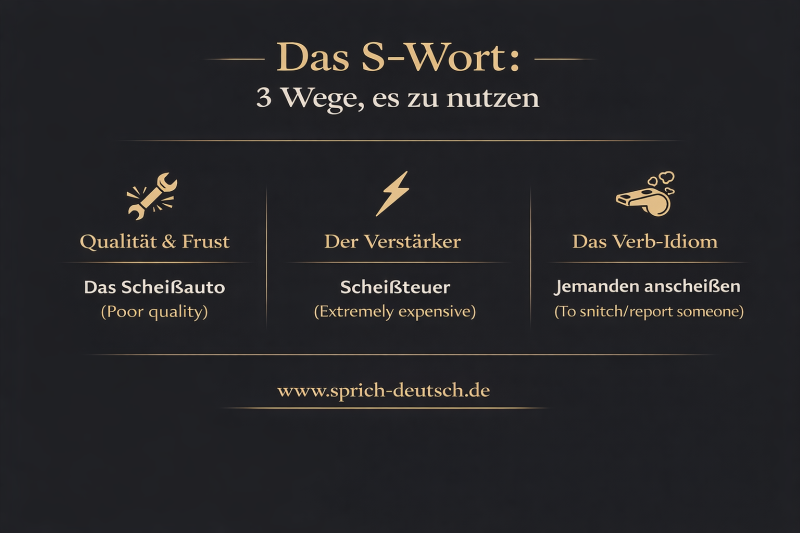
Why do Germans attach this word to so many things? From a linguistic perspective, “scheiß-” is an affixoid. This means it is a word element that attaches itself to other words like a building block, dramatically intensifying their meaning or adding emotional emphasis.
The Difference Between Noun and Adjective
- The noun prefix: Here it describes poor quality or frustration. Scheißauto (a car that constantly breaks down), Scheißwetter (rain, wind, cold). In this case, it functions similarly to the English word “shitty.”
- The adjective prefix: Here it acts purely as an intensifier. “Der Test war scheißschwer!” simply means “extremely difficult.” Interestingly, it can even be positive: “Der Lehrer ist scheißfreundlich!” meaning the teacher is incredibly friendly.
The Frustration Scale: From “Mist” to “Scheiße”
Not every situation calls for the S-word. Imagine you are on an emotional scale from 1 (slightly annoyed) to 10 (absolute rage). Which word do you choose?
Ideal when you have left your keys inside your apartment. Socially, these are almost always acceptable, even in front of strangers.
For example, when your computer crashes and all your work is gone. Here, you are showing real, human frustration.
Very vulgar. This is reserved for moments of extreme anger. Never use it in a professional context!
Surprise! In youth slang, this means: “That is extremely cool!” It is used as a compliment for music, technology, or something impressive.
5 Expressions You Should Know
If you master these phrases, you will understand everyday German life much better:
- “Das ist mir scheißegal!” – Probably the most honest way to say: I don’t give a damn or Me importa un bledo.
- “Sich einscheißen” – Means to be very scared. “Scheiß dich nicht ein, die Prüfung wird schon klappen!”
- “Klugscheißer” – A know-it-all or sabelotodo, someone who always thinks they know better.
- “Einen Scheißdreck wissen” – When someone has absolutely no idea about a topic.
- “Auf jemanden scheißen” – To have no respect for someone or to ignore their opinion.
Swearing Across Languages: A Comparison
Many language learners translate “Scheiße” directly, but the emotional intensity varies from one language to another:
| German | English (US/UK) | Spanish (ES/MX) |
|---|---|---|
| Scheiß-Wetter | Shitty weather | Clima de mierda |
| Scheißegal | I don’t give a sh*t | Me la suda / Me vale |
| Klugscheißer | Smart-ass | Sabelotodo |
Office Etiquette: Can You Say This at Work?
In the German workplace, professionalism is taken very seriously. Still, there are subtle differences depending on the situation:
When it is acceptable: Informally among close colleagues when everyone is venting about a system, a process, or a frustrating decision. In some cases, it can even strengthen team spirit.
When it is taboo: In formal meetings or when speaking to managers or clients. In these situations, it is better to use more “diplomatic” expressions:
- “„Das ist suboptimal.”” (Meaning: This is complete nonsense).
- “Damit bin ich unglücklich.” (Meaning: This really annoys me).
- “Das ist eine Herausforderung.” (Meaning: This is a nightmare).
Bescheißen, Anscheißen & Co.
The word family built around the S-word offers verbs for almost every situation in life:
- bescheißen: to cheat or deceive someone. “Der Verkäufer hat mich beim Preis beschissen.”
- anscheißen: to report someone to an authority or criticize them harshly. “Er hat mich beim Chef angeschissen.”
- ausscheißen: to excrete something that has been digested
- Kack- (the “softer” alternative): “Kackwetter” is almost identical in meaning but sounds slightly less aggressive, almost a bit childish or playful.
Conclusion: Swearing as Part of Integration
Learning German means understanding the soul of the language. If you know when a heartfelt “Scheiße!” is acceptable and when it is better to stick with “suboptimal,” you have developed a real feeling for the language. Swearing can make you sound authentic, as long as you know the right dose.
Learn more about German:


